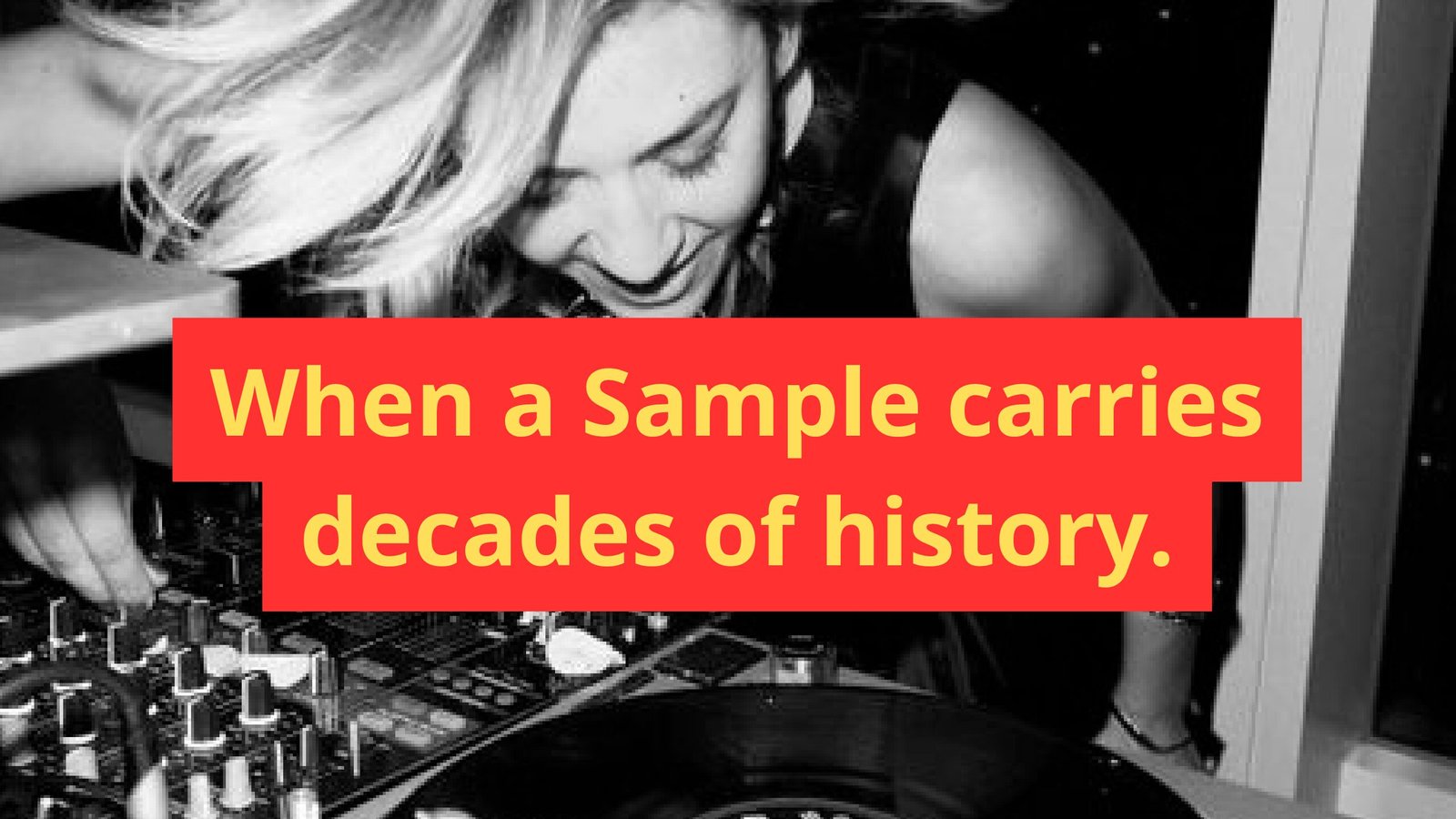
It’s Not Just a Snare. It’s a Scene.
In the age of drag-and-drop DAWs, sampling has become a default.
But beneath the surface of a loop lies a deeper question:
Are you sampling just to fill space — or to carry history?
Because a real sample isn’t just a sound — it’s a symbolic fragment of culture.
A coded message from the past.
A bridge between eras, movements, and identities.
From Sonic Shortcut to Sonic Relic
Today, thousands of producers rely on recycled packs and overused textures.
It’s convenient. It works. But…
Convenience is the enemy of context.
Most samples in the wild are:
- Stripped of origin
- Disconnected from narrative
- Reduced to aesthetic flavor
And when we lose the why behind the sound, we also lose the weight it once carried.
Sampling Is Excavation — Not Extraction
A powerful sample isn’t about technical precision — it’s about cultural resonance.
It might contain:
- The crackle of a protest march on vinyl
- The swing of a gospel groove lifted from struggle
- The grit of a cassette ripped in a smoky basement
These aren’t just textures — they’re emotional residues.
Great producers know that sampling is not cutting — it’s curating.
It’s about listening deeply. Interpreting carefully. Translating respectfully.
Sound with Soul Is Sound with Roots
The reason some beats hit deeper than others isn’t their BPM or mixdown.
It’s that they pulse with layers: historical, political, emotional.
In hip hop, samples are soul carriers — not shortcuts.
And in electronic music, we’re finally seeing producers return to that ethic:
Digging. Flipping. Contextualizing.
Not to imitate the past — but to reanimate it.
A great sample doesn’t just reference.
It reframes.
Sampling Requires Intention
We live in a loop-saturated world. But the best producers make loops that live.
They:
- Search beyond the obvious
- Ask what the sample meant then, and what it could mean now
- Treat curation as composition
- See the sampler as both instrument and archive
When this intention is present, technique meets emotion — and the result is unforgettable.
Your Ears Are Your Archive
Sampling is less about software and more about sensibility.
The difference between a forgettable drop and a spine-chilling moment is curation.
A sense of timing. Texture. Memory.
And ultimately, respect:
For the sound.
For its origin.
For its ability to say what synths alone never could.
Final Thought: A Sample Is a Story You Didn’t Write — But You’re Responsible for Telling
So treat it like one.
Honor it. Twist it. Elevate it. Make it yours — but never erase where it came from.
Because in the right hands, a tiny slice of audio can hold entire generations of meaning.
And when that happens, you’re not just producing music.
You’re carrying culture.